Scaring Yourself Stupid
Schopenhauer offered some useful insight on the matter, and so will I.

We might agree that the German philosopher Arthur Schopenhauer was an irascible sort; complex, uneven, and hypocritical, as is everyone’s nature. No man, after all, is an unfailing metronome. Despite the overarching pessimism, the great philosopher’s musings reveal occasional episodes of uplift, even optimism, though these episodes are subsequently revealed to be fleeting interregnums. Schopenhauer spent most of his conscious moments baking in misanthropy and nihilism, par for the course for his particular trade.
Schopenhauer thought, as most philosophical tradesmen still think, that the great majority of men are incapable of thinking and inaccessible to reason. The insight is hardly profound, even if it is undoubtedly just. Twenty-five hundred years ago, in a land and a time far away, imbued with a culture and savants we can only assume existed, Aristotle had opined similarly, noting that the great majority of men were natural dunces and sluggards. To continually regard most of mankind as a deadweight loss will understandably stunt one’s enthusiasm for the future.
We should also remember that the mere act of existing has been a great chore through most of history. War, suppression, civil unrest, religious persecution, ravaging disease have punctuated (and continue to punctuate) human existence without relief. That the human species of Schopenhauer’s era (and all previous eras) were required to breed like reptiles to ensure that one or two progeny survived to adulthood and, thus, to ensure the familial lineage, imbued society with a particular misery unknown to most of us in a modern Western society. So many times a soul was consigned to shivering in the loneliness of inconsolable grief. We should forgive a bloke for pumping a fist at the heavens when a conscience is continually tormented with existential crises.
Most things remain the same, given the immutability of our nature. Then, as now, it’s always about me. In the grand scheme of the space between our ears, the foibles, follies, inequities, and tragedies of the world register only when they disrupt our well-being. We, as individualized units, care about “I” above all. Should the choice distill to you or the world, you take precedence. The human species swarms with imbeciles, but the option to separate is an immediate panacea, and the imposition on our lives is thus negated, and so, in the end, we sleep soundly at night. Let a toothache interrupt that sleep, on the other hand, and the world can go to hell.
I see something more basic, and mostly carnal, that troubles the conscience of our celebrity antiquated philosophers — involuntary celibacy. Most philosophers have held a dim view of the human race, and most women have held a dim view of philosophers. Schopenhauer was luckless with the ladies, as was his fellow Teutonic recluse Friedrich Nietzsche, whose efforts were further thwarted by a ridiculous push-broom mustache (a vexing deterrent for our philosopher that was easily enough remedied). Kant, also feckless at amour, remained more upbeat in his demeanor. Instead of extracting his revenge with misanthropic vitriol, he baffled with a bunch of a priori/a posteriori omphaloskepsis. And Goethe? Every profession mutates a few exceptions.
(Sidebar: Those noble philosophers of Gallic heritage who lived southwest of what would eventually form the German/France border were the notable exceptions to the incel purgatory. Montaigne was renowned as a first-rate enchanter when he wasn’t disabled by kidney stones. Rousseau was often enough fawned upon in distaff society, possibly because he wrote enough of that naturalistic, sentimental prose that appeals to feminine sensibilities. Voltaire was Casanova sans the scoundrelism. This great philosopher of reason kept company with women of France’s highest society, and who are we to judge if one of them just so happened to be his niece?)
Schopenhauer viewed the world through a jaundiced eye, but this holistic enmity tinged the philosopher with a few commendable, mostly Stoic, virtues — uncompromising honesty and lucidity standing out most.
Just as we’ll find the man who declares his honesty is anything but honest, so we’ll find sense pronounced as common anything but. A cursory inventory of culture reveals most of what passes as common sense is, on the contrary, usually uncommonly preposterous. Repetition might ensure commonality; it has no bearing on sensibility. Schopenhauer saw through the facade, and no more so than in his essay titled On Reading and Books.
How often we are exhorted to read, and how infrequently the exhortation is followed with only if one discerns. Through anecdotal observation that I would wager is supported by empirical evidence, I aver that most people fail miserably regarding the latter. Schopenhauer notes as much in his essay, and by failing to discern, Schopenhauer avers, “[T]hey [many men] have read themselves stupid.” Here, again, I suspect that the anecdotal is supported by the empirical.
Indiscriminate reading is evinced today in the proliferation of and the addiction to list articles: 10 Ways to Improve This, 5 Ways to Increase That, 50 Ways to Leave Your Lover — ready tidbits of easily digestible mind candy soon forgotten after consumed, though sure enough to leave the consumer flaccid. List the ways you’ve improved by reading listicles, and then list the number of listicles and the time you’ve wasted on each. I suspect zero on the former and some embarrassingly high number on the latter, such is the price of a dopamine hit.
When information is offered in some other form than a list, it’s offered to accentuate the negative (though the two aren’t necessarily mutually exclusive). “If it bleeds, it leads” is more than a cliche; it’s standard operating procedure for most media outlets. Chaos, crisis, collapse: if you haven’t been frightened into apoplexy, the editors have failed at their duty. I offer a ready example — a random screenshot of any Yahoo Finance landing page posted on any random day.
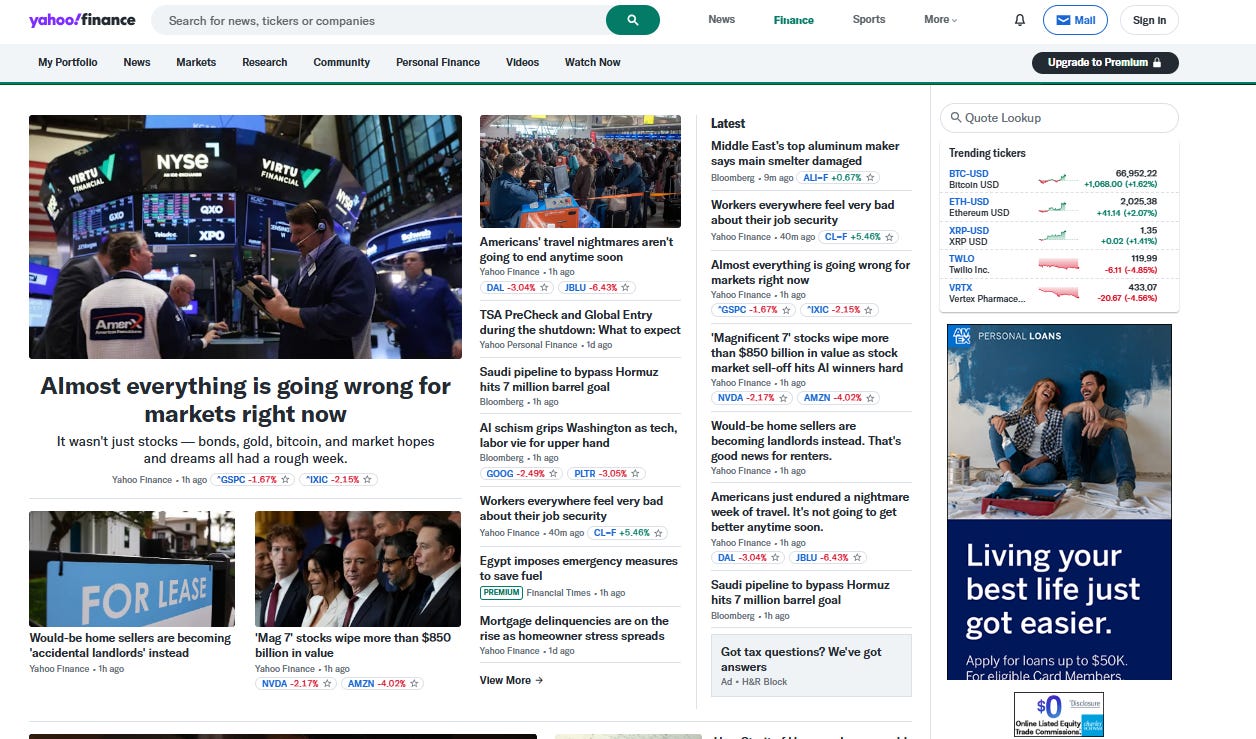
What a waste it all is, of time and equanimity.
When is one empowered by fear? We are rightly told that “now is not the time to panic,” which, of course, the cynical wit must riposte with, “When is the time to panic?”
But many do panic, and most often when rational decisions are most desired. Fear is the corollary to panic. When you're in a fright, when the collapse and chaos is near (neither of which you have approached experiencing, but never mind), you can be assured of deciding in favor of stupidity. Unfortunately, we find the imperative difficult to resist because our brains have been overloaded with pessimism. We feel compelled to do something when in hindsight we would have been best served to have done nothing.
This is nothing new, because has been nothing new under the sun since the first generation. Thomas Babington Macaulay, nineteenth-century British luminary, historian, and poet, noted our proclivity for accentuating the negative, thus raising our dander, firsthand in the Britain of his day. Here is Macaulay’s observation of fearmongering and its resultant absurdity pinched from his intimidatingly dense and prolix The History of England. Fast forward two hundred years and substitute “United States” for “England” and the song remains the same.
Under the prodigal administration of the first William Pitt, the debt rapidly swelled to £140 million. . . . Men of theory and men of business almost unanimously pronounced that the fatal day had now really arrived. . . . It was possible to prove by figures that the road to national ruin was through the national debt. It was idle, however, now to talk about the road; we had reached the goal; all was over; all the revenues of the island . . . were mortgaged. Better for us to have been conquered by Prussia. . . . And yet [one] had only to open his eyes to see improvement all around him, cities increasing, marts too small for the crowd of buyers, harbors insufficient to contain the shipping . . . houses better furnished . . . smoother roads.
[After the Napoleonic War] the funded debt of England amounted to £800 million. It was in truth a . . . fabulous debt; and we can hardly wonder that the cry of despair should have been louder than ever. . . . Yet like Addison’s valetudinarian, who contrived to whimper that he was dying of consumption till he became so fat that he was shamed into silence, she went on complaining that she was sunk in poverty till her wealth . . . made her complaints ridiculous. The . . . bankrupt society . . . while meeting these obligations, grew richer and richer so fast that the growth could almost be discerned by the eye.
Never have we experienced such material prosperity that we experience at this very moment, and never has it required so little exertion to procure, and yet we’ve never been more depressed, more lonely, more stressed at any time in history. People read themselves into misery with no perception of what real misery entails. Transport yourself back only two hundred years. If you weren’t suffering with gout, kidney stones, or syphilis, you were dying from dropsy, smallpox, or consumption. If you weren’t grieving for the loss of your own child or spouse, you were consoling a family member or friend who did. Crises then were existential because they were damn real as opposed to the imagined crises manufactured in modernity.
Thomas Szasz was on to something when he wrote The Myth of Mental Illness (a non-stupefying read) sixty-five years ago. What you infer (or what at least what I inferred) is that mental illness is mostly a modern incarnation of Munchausen syndrome. Reading nothing but negative news warps the perspective. You could be luxuriating in the mythical land of Cockaigne, and yet if you ingest nothing by a continuous feed of criticisms and shortcomings, you’d swear you were burning in Hades.
The self-improvement genre is a formidable titan in the publishing world. It preys upon two universal mental handicaps: inadequacy and fear. The global self-help industry (which includes endless books, audiobooks, self-styled gurus, and apps) is valued in the billions of dollars. Self-improvement titles excel as audiobooks. While fiction categories see high turnover, individual self-help books frequently sit atop the overall unit sales charts for years at a time.
I suspect that very few, if anyone, have been improved by this rubbish heap of pop culture literature dating back to Napoleon Hill’s Think and Growth Rich. It had all been explicated centuries before, and in more insightful prose, than most of what passes as self-improvement today. An outlier or two may ascribe his success to one of the myriad paint-by-numbers books populating the genre. (And God forbid should you spend a dollar on any of Tony Robbins’ worthless casuistry.) If we were to delve deeper, I’m sure we’d find contributing evasive factors unrelated to the author’s tidy nostrum. When you venture down the self-improvement sewer pipe, you’re sure to be further addled by, well, sewage.
In the meantime, you’re manufacturing endless misery. When you’re not depressed by the news, you’re frustrated by paralysis through analysis. In the midst of unprecedented opportunities to learn at no cost, ignorance flourishes. We suffocate with uncoordinated facts; our minds are overwhelmed with information breeding and multiplying into specialistic chaos for want of synthetic thought and a unifying philosophy. Not only do we read ourselves stupid, as Schopenhauer asserts, but we also scare ourselves stupid, as I assert.
What are you to make of the following amalgamation of headlines? How do they inform, and thus empower you to confront the world, to decide, to advance into an always uncertain future?
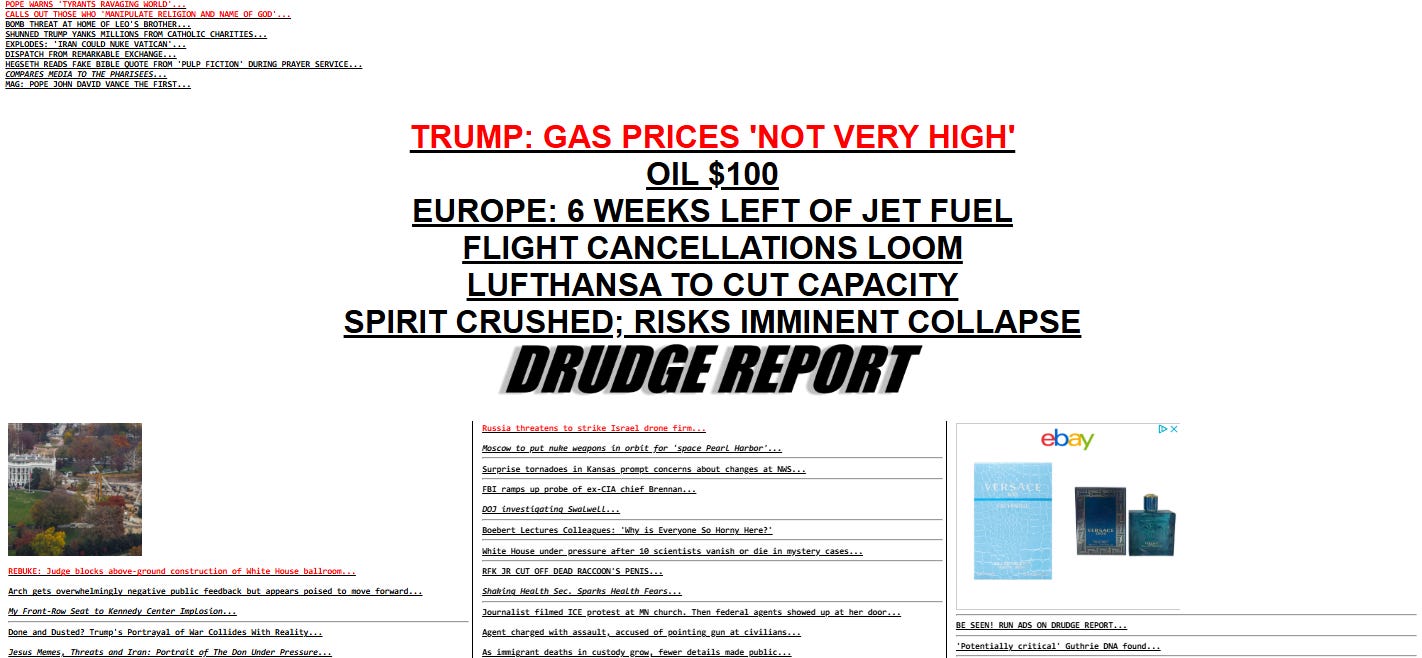
What a waste it all is, of time and lost equanimity. Do you remember the events of Western Pennsylvania two years ago? What was the name of the young Ukrainian woman stabbed to death on the light rail in Charlotte? Who was the leader captured in January by U.S. special forces and what was his country? Who was named in the Epstein files and has anyone been prosecuted? Does anyone remember why Russia invaded Ukraine? It’s all ephemeral noise, all soon forgotten, though for that brief moment it riles indignation for no reason, and no individual can do a damn thing about it.
First alarmed, then depressed, then subjugated into inertia. That’s the game plan you pay for. You wait for perfection before investing, yet perfection never arrives. You cancel your vacation to Tulum because you read a harrowing account of two tourists kidnapped and murdered, oblivious to the particulars. You submit to multiple vaccinations, public masking, to the quaint, euphemistic “sheltering in place,” or, to delete the ridiculous euphemism, house arrest. You acquiesce to self-subjugation because you’re scared, and because of what you have read and accepted as gospel, having not gleaned a smidgeon of understanding of human history despite all your reading. "Land of the free and the home of the brave” — maybe when Francis Scott Key scribbled this bit of idealism on vellum two hundred and fifteen years ago, but I doubt it even then.
Contrary to all the propagandizing/inculcating on freedom Americans have been subjected for the past two hundred and fifty years, I’m convinced the opposite prevails. The majority fear freedom more than enslavement because freedom entails uncertainty attenuated only by responsibility, and uncertainty is the kindred spirit of fear. Most of what we read accentuates the unforeseen disasters.
In the “Grand Inquisitor” chapter of Dostoevsky’s The Brothers Karamazov, the Inquisitor character argues that instead of seeking freedom, humanity flees from freedom: “I tell Thee that man is tormented by no greater anxiety than to find someone quickly to whom he can hand over that gift of freedom with which the ill-fated creature is born. But only one who can appease their conscience can take over their freedom. In bread there was offered Thee an invincible banner; give bread, and man will worship thee, for nothing is more certain than bread.”
People seek relief from the immensity of uncertainty above all and are willing to pay the highest price. Uncertainty is never amplified by the positive, only by the negative: How can it all go enormously wrong and go wrong of our own hapless accord? Let’s visit any media outlet and count the ways.